Project Plan
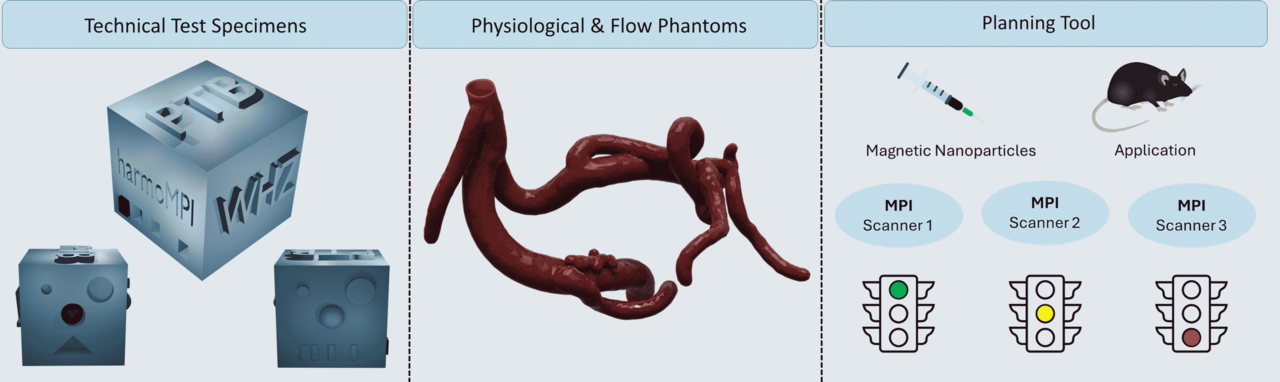
The main objective of the joint project of PTB and WHZ is to demonstrate the fundamental performance of MPI in a quantitative framework based on a complete, consistent and traceable comparison of different MPI scanner systems. It is planned to achieve consistent comparability of MPI using new, platform-independent phantoms to enable and accelerate multi-center preclinical studies. A planning tool, which is yet to be developed, allows the best possible measurement configuration (or MPI scanner architecture) to be selected for a given measurement task. This enables improved test planning, which leads to a decrease in animal testing by avoiding conducting studies with poor prospects of success. We develop universal phantoms with a modular concept and demonstrate their functionality in experimental measurements. The phantoms allow for measurement of spatial and temporal resolution, as well as sensitivity. Furthermore, anatomical structures are integrated to test system performance for medical applications.
In addition, the knowledge gain obtained by the development of long-term stable phantoms and the subsequent harmonization of the different MPI architectures and devices offers potential for harmonizing other tracer-aided imaging modalities. The universal approach to reach the goals addressed will not only offer new analytical possibilities for planning experiments and for quality assurance but also enable physiological model experiments on diverse MPI scanner types.
The following objectives are to be achieved within the project:
- Providing platform-independent reference objects
- Additive manufacturing for producing geometrically complex tracer phantoms for MPI
- Developing a procedure for determining the imaging performance of MPI scanner systems
- Planning tool for selecting a suitable MPI scanner and determining the prospects of success in a specific preclinical application